
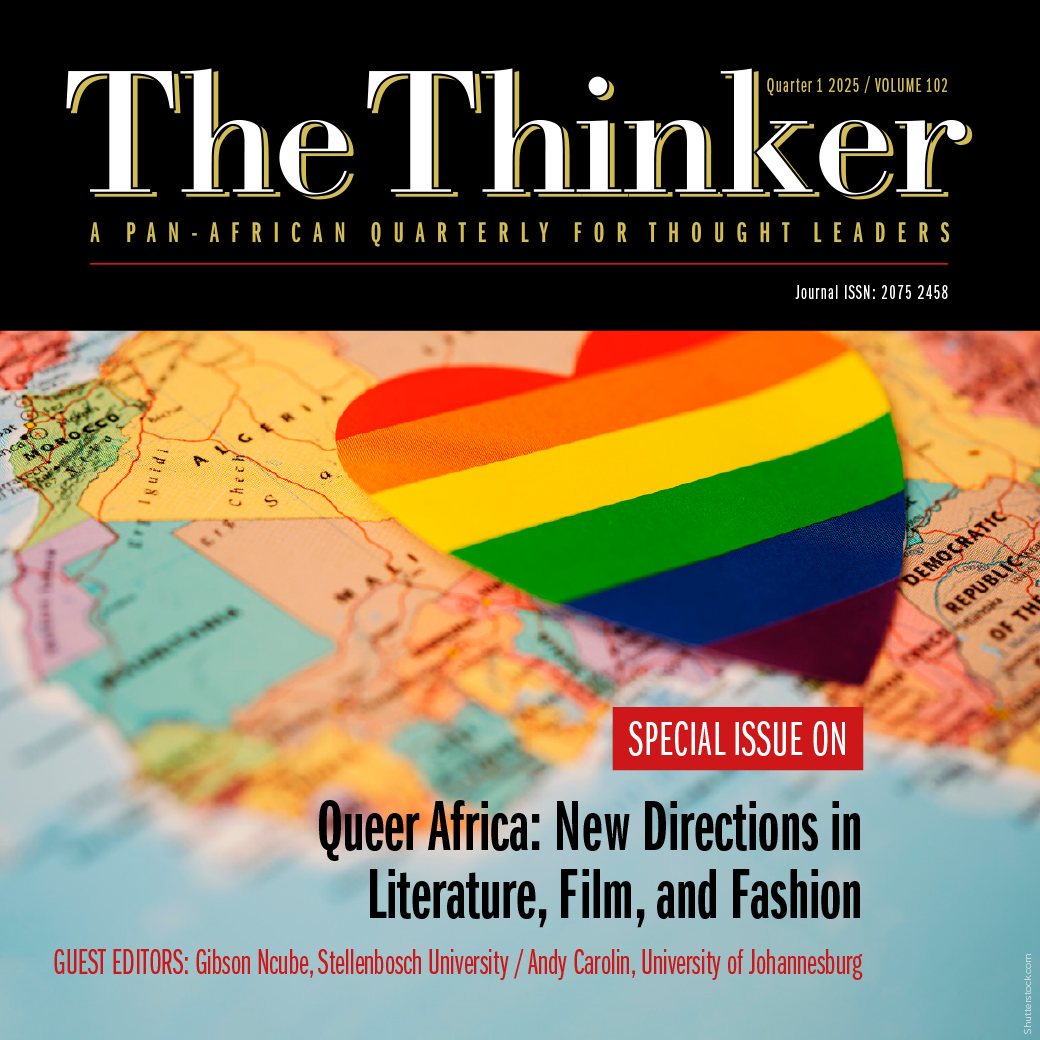
Queer Africa New Directions in Literature, Film, and Fashion
Article Sidebar
Main Article Content
Abstract
The last decade has seen a proliferation in cultural productions that represent and narrativise queer lived experiences in Africa. Concomitantly, there has also been a growing body of scholarly work which has attempted to intellectualise these diverse cultural productions. However, as noted by Osinubi, “[w]ithin African queer scholarship, debates on good social practices concern the uneven constitution of the field and the responsibilities of scholars towards globally dispersed African communities” (2018, p.597). One of the most pressing challenges facing queer African studies has been this uneven constitution of the field, where much of the scholarship is produced by scholars who are either not African or are not based in Africa. Most of the scholars in the field are located in the Global North and work within institutions that have the capital to shape the production and dissemination of knowledge. What this does, in many instances, is to exclude or marginalise Africa-based scholars. This exclusion and marginalisation of African scholars, as Musila (2025) explains, is materialised in the way that scholarship from Africa and by African scholars is framed as belated. According to Musila, the “charge of belatedness is often framed in the diction of lack – lack of originality, lack of theoretical rigour, out of step with contemporary debates in the field of study, redundant” (2025, p.2).
References
Gevisser, M. (2020). The pink line: journeys across the world’s queer frontiers. Johannesburg: Jonathan Ball Publishers.
Musila, G. A. (2025). The promise of belatedness for Africa-based scholarship. African Studies, pp.1-15.
Ncube, G. (2025). Queer bodies in African films. Makhanda: NISC.
Osinubi, T. A. (2018). Introduction: denormativizing imperatives in African queer scholarship. College Literature, 45(4), pp.596-612. DOI: https://doi.org/10.1353/lit.2018.0034
van Klinken, A. (2020). Queer Pan-Africanism in contemporary Africa. In: Rabaka, R., ed. The Routledge handbook of Pan-Africanism. New York: DOI: https://doi.org/10.4324/9780429020193-23
Routledge, pp.343-354.
Downloads
Article Metrics Graph
Article Details

This work is licensed under a Creative Commons Attribution 4.0 International License.